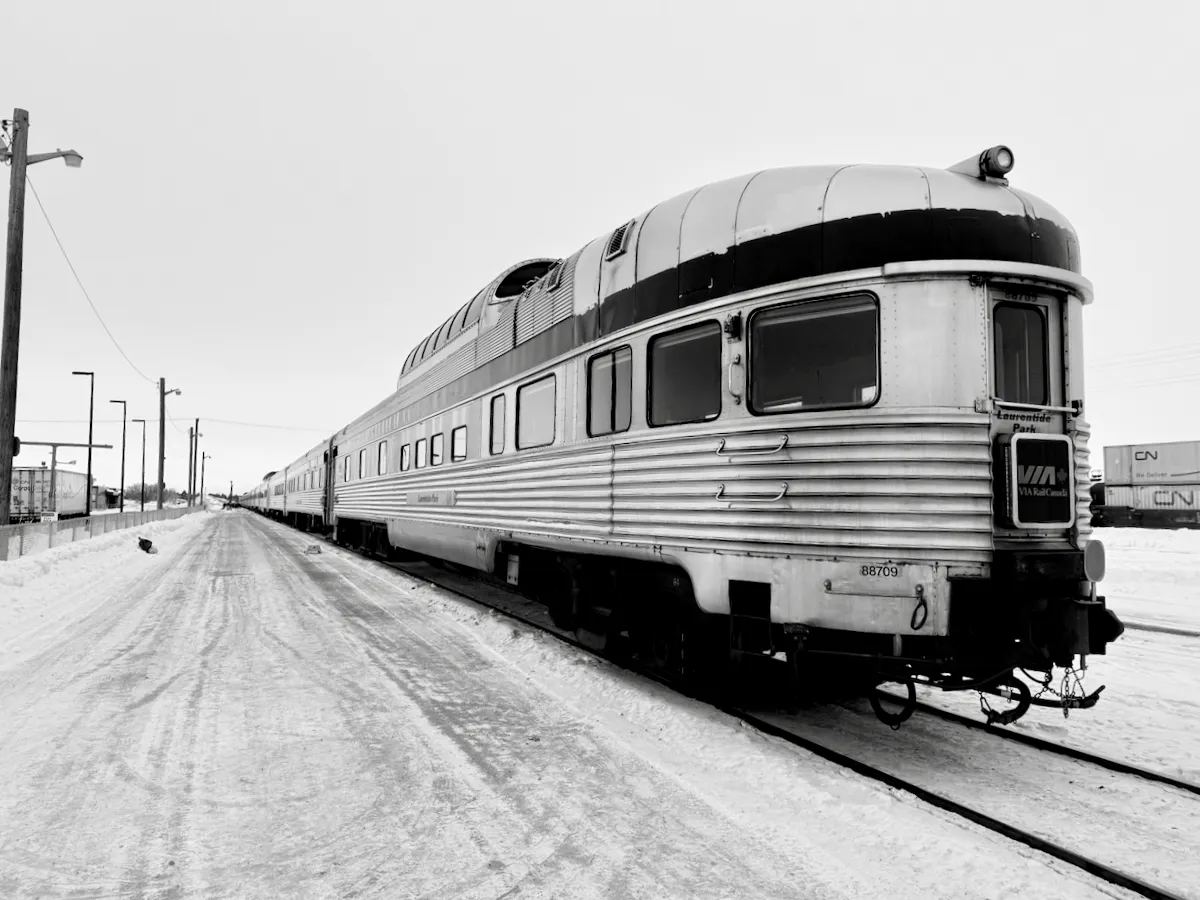
I’ve ridden long-haul sleepers across Europe and Asia, but VIA Rail’s The Canadian in Sleeper Plus still surprised me: the food genuinely rivals a good restaurant, the dome car views are stunning, and the cabin privacy works, but only if you book a Sleeper Plus cabin (or better).
Who this trip is perfect for (and who should skip it)
You’re planning your first or second big overland journey, you want to do it right without the stress of piecing together connections, and you’re drawn to the idea of crossing a continent whilst someone else cooks your meals and makes your bed. The Canadian is built for you. This is not a commuter service. It’s a 4,466-kilometre, four-day, four-night rolling hotel through the Rockies, Prairies, and boreal forest, where the scenery is the point and punctuality is not (which we learned to our detriment).
Skip this trip if you must arrive in Toronto (or Vancouver) on a fixed date for a flight, cruise, or meeting. Freight trains own the tracks; VIA’s passenger services yield to them, and delays of 6-12 hours are routine, sometimes more. On my winter trip, we were lucky to get that delay down to 2.5 hours. Choose The Canadian if you value all-inclusive comfort, dramatic landscapes, and the luxury of slow travel. Skip it if you’re hunting the cheapest A-to-B or need a guaranteed on-time arrival.
This review covers:
- Sleeper Plus cabin comfort, toilets, showers, and sleep quality
- Food quality across breakfast, lunch, and dinner over four days
- Pricing reality (yield management decoded) and when to book
- Dome car access, onboard activities, and scenery windows
- Delays, freight priority, and forum sentiment from recent travellers
- Sleeper Plus vs Prestige vs Economy: which tier makes sense for your budget
Route basics and what Sleeper Plus actually includes
The route: Train #1 departs Vancouver, calling at Kamloops, Jasper, Edmonton, Saskatoon, Winnipeg, Sioux Lookout, Sudbury Junction, and Toronto. Train #2 runs the reverse. Distance is roughly 4,466 kilometres; scheduled duration is four days and four nights, but expect longer due to freight traffic. Recent travellers report arrivals up to 24 hours late in extreme cases.
What Sleeper Plus includes in your fare: private or semi-private sleeping space with beds, linens, pillows, and blankets; all meals (breakfast, lunch, dinner, plus snacks and non-alcoholic drinks); access to the dining car and Skyline dome car; priority boarding over Economy passengers; and occasional onboard activities such as wine tastings or live music (not guaranteed year-round, but we had a guitarist singing Canadiana in December, if that’s any measure).
Sleeper Plus accommodation types:
- Upper/Lower Berth: seats by day, bunks with privacy curtains by night; shared toilets and showers nearby. Budget option, minimal privacy.
- Cabin for One: seat by day, bed by night, private toilet and sink in-cabin, shared shower down the hall. Solo traveller sweet spot and my choice.
- Cabin for Two: two armchairs by day, upper and lower bunks by night, private toilet and sink, shared shower in car. Best privacy-to-price ratio for couples.
- Cabin Suite: two Cabins for Two combined, more space, ideal for families or couples wanting elbow room.
Entry requirements (non-Canadians): immigration happens at your first Canadian entry point (airport, land border, or port), not on the train. Most visa-exempt travellers need an eTA (Electronic Travel Authorization) for air arrival; overland arrivals from the US require only valid ID tied to your ticket. Always confirm current rules on the official Government of Canada IRCC website before booking. Policies change.
Best season at a glance: Winter (December-February) offers snow-covered Rockies, lower fares, and possible Northern Lights, but short daylight and cold-related delays. Shoulder season (March-May, October-November) balances price and experience, with easier dome car access, decent weather, and fewer crowds. Peak summer (June-September) delivers long daylight, clearest mountain views, and highest fares; Sleeper Plus Cabins and Prestige sell out months ahead.
Booking and pricing: yield management decoded
VIA Rail uses yield-managed pricing, meaning the same Cabin for Two on the same train can cost CAD 2,200 per person in March or CAD 3,500+ in July, depending on demand, promos, and how far ahead you book. There is no rack rate, only what the algorithm thinks it can charge today.
Typical one-way fares (Vancouver-Toronto or reverse, per person, based on 2024-2025 data):
- Economy (seat only): CAD 450-600+ on sale; around CAD 500 for full route. No meals, no bed, access to dome car on space-available basis only. Fine for budget backpackers comfortable sleeping upright for four nights; miserable for most.
- Sleeper Plus Upper/Lower Berth: CAD 1,200-1,700 per person, low to mid season. Meals included, but privacy is minimal (curtain only, corridor noise).
- Sleeper Plus Cabin for Two: CAD 2,200-3,500+ per person depending on season. This is the sweet spot for most couples: private door, toilet, sink, meals, dome access.
- Prestige Class: Often 2-3 times Sleeper Plus cost; includes larger cabin, in-suite shower, premium meals, and concierge service. Frequently bundled in luxury tour packages; sells out earliest in peak season.
When to book: Summer departures (June-September) sell out 4-6 months ahead, especially Prestige and Cabins for Two. Shoulder season (March-May, October-November) offers the best value, with lower fares, easier availability, and still decent scenery. Winter (December-February) has the lowest fares but shortest daylight; book 2-3 months ahead for Christmas/New Year peak, otherwise 4-6 weeks is fine.
Which inventory disappears first: Prestige cabins vanish first (often within weeks of release), then Cabins for Two, then Cabins for One. Upper/Lower Berths are usually available closer to departure. If only berths remain and you want privacy, consider waiting for a cancellation or choosing a different date.
Decision tree:
- Solo traveller on a budget? Upper/Lower Berth.
- Solo traveller valuing sleep and privacy? Cabin for One.
- Couple wanting comfort without Prestige prices? Cabin for Two.
- Family or couple wanting space? Cabin Suite.
- Luxury splurge? Prestige.
What forums are saying: Complaints focus on peak-season price spikes (CAD 3,000+ per person feels steep when delays are common) and yield management opacity (same cabin, wildly different prices). Praise centres on “once-in-a-lifetime value” when you factor in four days of excellent meals, dome car access, and the sheer spectacle of the Rockies. Consensus: book early, accept delays, and treat it as an experience, not transport.
Sleeper Plus cabin comfort: the real UX
I’ve slept in couchettes across Europe and berths in India; VIA’s Sleeper Plus Cabin for One sits somewhere between a tiny European hotel room and a well-designed yacht cabin. It’s tiny, roughly 2 metres by 1.5 metres, but functional if you manage luggage smartly.
Cabin for Two layout: Two armchairs face each other by day, with a small fold-down table between them. At night, your attendant converts the space into upper and lower bunks (think ship berths, not hostel beds). There’s a small luggage rack above the door, hooks for coats, and a narrow wardrobe. The private toilet and sink are tucked into one corner; the sink is small but adequate for brushing teeth and washing hands. The shared shower is at the end of the Sleeper Plus car.
Luggage reality: Check large suitcases at Vancouver or Toronto (VIA holds them in the baggage car). Keep a small day bag or backpack in your cabin for clothes, toiletries, books, and electronics. The overhead rack holds one medium bag; anything larger will live on the floor or under the lower bunk, making the space feel cramped.
Sleep quality: The linen, pillows, and blankets are genuinely good, better than many mid-range hotels. The lower bunk is wider and easier to access; the upper bunk requires a ladder and feels snug (fine for kids or agile adults, awkward for anyone with mobility limits). Motion and track noise vary dramatically by section: smooth and rhythmic through the Rockies and Prairies, rougher and louder east of Winnipeg. Earplugs help.
Toilets and showers: The in-cabin toilet is efficient, comparatively odour-free (vacuum system), and surprisingly quiet for a train. The sink has good water pressure and there’s a spigot with drinking water. The shared shower at the end of the car is clean (attendants wipe it down after each use), has excellent water pressure, and is spacious enough to dress inside. You’ll have to get used to pumping the button to keep the water flowing. Timing tip: go early morning or late evening to avoid queues; mid-morning and pre-dinner are busiest.
Privacy and noise: Cabins for One and Two have lockable doors and solid walls, far better privacy than berths, which have only curtains and let corridor noise through. You’ll still hear your neighbours through thin walls (voices, toilets flushing, alarms), but it’s manageable. The bigger noise issue is the train itself: rail joints, freight horns, and station stops. I am a light sleeper, so I packed earplugs and an eye mask (the cabin has blackout blinds, but station lights and dawn sun creep in).
Berth reality check: If budget forces you into an Upper or Lower Berth, know this: you’re sleeping in a corridor with a curtain. It’s clean, the bed is made daily, and meals are identical to cabin passengers, but privacy is minimal, luggage storage is awkward (under the lower berth or overhead), and you’ll hear every footstep and conversation. Fine for solo backpackers or couples comfortable with hostel-style travel; frustrating for anyone expecting a private room.